Blesta Module
with Blesta.
Free Blesta module, set up in 10 minutes. Manage domain and hosting operations from one simple, user-friendly panel.
Manage domain registration, renewal, transfer and billing from a single panel with the Domain Name API Blesta module. Less manual work, faster operations.
- Free Module
- 800+ TLDs
- Automatic Billing
- Automatic Renewal
- DNS Management
- WHOIS Privacy
Free module • Live in 10 minutes • Start selling today
What is Blesta?
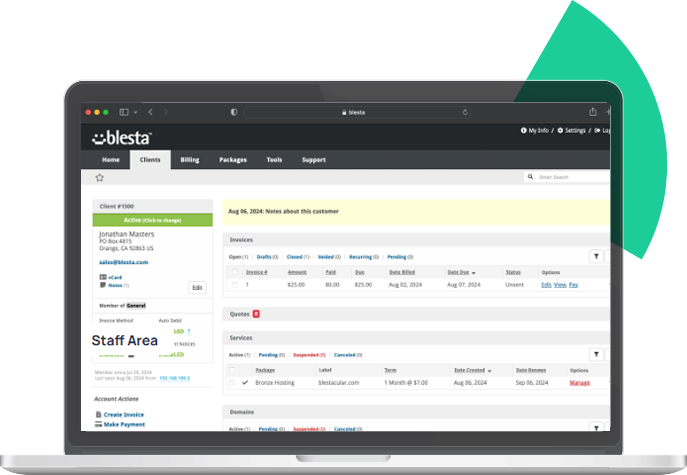
Blesta is a practical hosting management panel developed specifically for those providing web hosting services. With its user-friendly interface and powerful features, it allows easy control of domain and hosting operations from a single panel.
Blesta Module
Domain Name API Blesta Modules

Payment Options

Access Links

Integration

Module Structure

Security Features

Interface

and Announcements

and Support
Benefits of Using Blesta Control Panel

Currencies

Automation Systems

Why You Should Use Blesta Hosting Control Panel
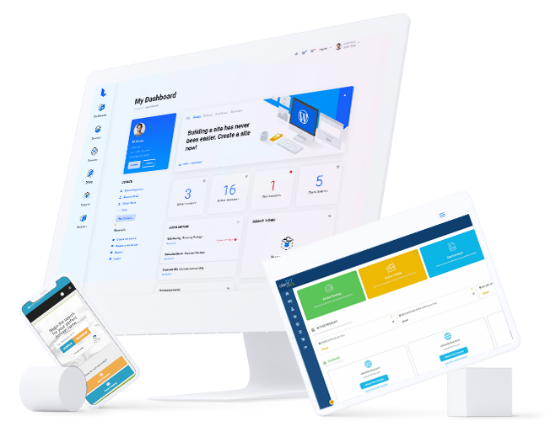
The Blesta Hosting & Domain Control Panel simplifies billing and purchasing processes with payment options such as Stripe, Authorize, and PayPal.
Orders are managed with automatic provider integrations, and invoices are automatically generated for purchased services and sent to your customers via email.
Automatic services such as freezing services for unpaid invoices and activating services when payment is received are performed automatically.
To boost your service sales, you can create custom discount codes for your site and offer discounts to users in any amount. With multi-currency support, your customers can pay in different currencies. The pro-rata billing feature can automatically generate invoices in the currency paid by your users and send them via email.
Blesta Automatic Billing System
Blesta offers a powerful automatic billing system for hosting and domain companies. Thanks to its flexible structure, users can customize payment cycles, tax rates, and payment methods as they wish. This payment flexibility provides a billing solution that suits the needs of new domain & hosting companies.
With Blesta's automatic payment reminder system and invoice renewal feature, manual follow-ups are eliminated. This helps customers make their payments regularly, while saving time for business owners and staff by reducing their workload and increasing customer satisfaction.

Blesta Control Panel Features


Blesta FAQ
Blesta is a billing, customer management, and hosting automation platform built for web hosting providers and domain resellers. It handles automatic invoicing, payment tracking, service activation, recurring billing, support ticket management, and service suspension/termination — all from a single admin panel.
For domain resellers, Blesta integrates directly with Domain Name API through a dedicated registrar module available at github.com/domainreseller. Once connected, domain registrations, renewals, transfers, DNS management, WHOIS updates, and WHOIS privacy protection are handled automatically via API — without any manual processing.
Blesta stands out for its open-source-friendly architecture, developer-first design, and one-time perpetual licensing model. It is a strong alternative to WHMCS for operators who prioritize data ownership, code-level customization, and predictable long-term costs.
💡 Blesta's perpetual license is its most compelling commercial differentiator. Unlike WHMCS's monthly subscription, you pay once and own the software indefinitely. For a reseller business that will run for 3+ years, Blesta's total cost of ownership is typically significantly lower than WHMCS. Domain Name API's module supports Blesta with the same feature depth as WHMCS and HostBill.
The Domain Name API Blesta module is available at github.com/domainreseller. Minimum requirements before installation: Blesta 5.3 or higher, PHP 7.4 or higher (PHP 8.1 recommended), and the PHP SOAPClient extension enabled on your server.
Installation steps:
- Download the latest module package from github.com/domainreseller.
- Upload the module files to your Blesta installation directory according to Blesta's registrar module placement guidelines.
- In the Blesta admin panel, navigate to Settings > Company > Modules and find the Domain Name API registrar module.
- Click Install, then enter your Domain Name API reseller username and password.
- Save and use the Test Connection option to confirm your credentials and balance are recognized.
- Go to Settings > Company > Registrar Modules and configure domain pricing for the TLD extensions you want to sell. Use the bulk TLD import to pull live pricing from Domain Name API and apply a profit margin in a single step.
If you are selling .tr domains for the Turkish market, configure the custom client fields for TR ID Number, Tax Number, and Tax Office during this step — these are required by the .tr registry.
Note: Always back up existing module files before upgrading.
💡 The most common post-installation issue is forgetting to enable domain synchronization. Without it, Blesta's expiry dates drift from Domain Name API's actual registry data, causing billing on incorrect dates and unexpected domain drops. Enable domain sync immediately after installation and verify it is running correctly before onboarding your first customers.
Yes — and full automation is the primary reason to use this integration. Once the Domain Name API module is configured in Blesta, the following operations are handled automatically via API with no manual intervention:
- domain registration and instant activation
- domain renewal and billing
- domain transfer with EPP code support
- DNS record management (A, MX, nameserver)
- WHOIS contact information updates
- WHOIS privacy protection
- transfer lock management
- premium domain support
On the hosting side, Blesta integrates with cPanel/WHM, Plesk, DirectAdmin, and other major control panels, enabling automatic hosting account provisioning, suspension, and termination alongside domain automation.
Customers manage their domains, DNS records, and WHOIS data directly through the Blesta client portal — reducing support load for resellers.
💡 Automation quality directly affects customer satisfaction and support ticket volume. A well-configured Blesta + Domain Name API setup should handle 95%+ of domain lifecycle operations without any staff involvement. The remaining 5% — edge cases like failed transfers, registry-side errors, and .tr compliance issues — are surfaced clearly in Blesta's module logs, making resolution fast.
Yes. Blesta is a technically mature and commercially competitive WHMCS alternative, particularly for resellers who prioritize three things: data ownership (Blesta is self-hosted and open-source-friendly), developer customization (clean codebase, documented APIs, modular architecture), and cost predictability (perpetual one-time license vs. WHMCS's ongoing monthly fee).
Both platforms offer equivalent core functionality for domain and hosting automation. Domain Name API provides dedicated, feature-equivalent modules for both Blesta and WHMCS, so the domain automation capability is identical regardless of which platform you choose.
Blesta's ecosystem is smaller than WHMCS's — fewer third-party themes and plugins are available. For operators who need a large marketplace of pre-built add-ons, WHMCS has the advantage. For operators who want a clean, self-owned platform they can build on, Blesta is the better fit.
💡 If you are starting a new reseller business in 2025–2026 and evaluating Blesta vs WHMCS: run the 3-year total cost of ownership calculation first. Factor in Blesta's one-time license, optional support renewals, and development time against WHMCS's monthly fee at your expected client tier. For many early-stage resellers, Blesta wins on cost. For operators who need WHMCS's third-party ecosystem (specific payment gateways, regional integrations, custom themes), WHMCS may still be the right choice.
To run Blesta with the Domain Name API module, your server must meet the following requirements:
- Blesta version 5.3 or higher
- PHP 7.4 or higher (PHP 8.1 recommended)
- PHP SOAPClient extension enabled
- MySQL 5.0 or higher
- a web server (Apache or Nginx)
An SSL certificate is required for the admin panel and client-facing storefront.
For .tr domain sales in the Turkish market, custom client fields for TR ID Number, Tax Number, and Tax Office must be configured in Blesta. These are mandatory fields required by the .tr registry — without them, .tr registrations will be rejected.
Always check github.com/domainreseller for the most current module requirements, as these may be updated with new Blesta or PHP releases.
💡 Run Blesta on a VPS with at least 2 GB RAM for production use. Shared hosting environments create stability issues under billing automation load — cron jobs, invoice generation, and domain sync all run on schedule and compete for resources. A dedicated or cloud VPS with automated daily backups is the right infrastructure choice for any live reseller business.
Blesta integrates with all major hosting control panels: cPanel/WHM, Plesk, DirectAdmin, SolusVM, and others. This allows automatic hosting account provisioning, suspension, and termination alongside domain management.
On the payment side, Blesta supports Stripe, PayPal, Authorize.Net, credit card processing, bank transfer, and various regional payment gateways. Multi-currency invoicing is supported natively — customers can be billed in their local currency while your costs from Domain Name API are denominated in USD, with conversion and margin management handled by Blesta.
Blesta also includes pro-rata billing, which automatically calculates and invoices the correct amount when a customer upgrades or changes their billing cycle mid-period.
💡 Multi-currency support combined with Domain Name API's USD-denominated cost data creates a clean margin management setup. Define your cost currency as USD in the Domain Name API module, set your markup percentage, and let Blesta handle customer-facing currency conversion. This removes manual pricing work when exchange rates fluctuate — particularly relevant for resellers serving Turkish, MENA, or Central Asian markets.
Yes. Blesta is built on a modular architecture that makes adding new integrations and customizing existing functionality straightforward. The platform exposes a documented API and a clean module development framework, which makes Domain Name API's registrar module — and any custom development you need — implementable without hacking core files.
Third-party modules for Blesta are available through the Blesta Marketplace and community repositories, covering additional payment gateways, fraud detection, additional registrars, and more.
Because Blesta is open-source-friendly and self-hosted, you have full access to the codebase for custom development — unlike WHMCS, which restricts core file access.
💡 Blesta's developer-friendly architecture is a genuine operational advantage for resellers with technical teams. Custom client portal features, non-standard billing workflows, and regional compliance requirements (like Turkey's .tr ID validation logic) can be implemented directly without waiting for official module updates. This is the use case where Blesta clearly outperforms WHMCS for technically capable operators.
Yes. Blesta includes a built-in support ticket system that allows customers to submit, track, and receive responses to support requests directly from the client portal. The ticketing system supports department routing, priority levels, and email-based ticket creation.
Support ticket workflows can be customized — for example, automatically routing domain transfer requests to a dedicated team, or setting escalation rules for unpaid invoice reminders.
For domain-specific issues, Blesta's module log records all API requests and responses between Blesta and Domain Name API, making it straightforward to diagnose and resolve domain operation failures without requiring support escalation in most cases.
💡 Train your support team to check Blesta's module log before escalating domain issues to Domain Name API. The log entry for a failed domain operation contains the exact API response — in most cases the error is self-explanatory (invalid EPP code, registry lock, insufficient balance, .tr ID mismatch). Having this log excerpt in any support ticket you open with Domain Name API cuts resolution time significantly.
Blesta generates invoices and sends payment reminders automatically based on the billing cycle configured for each product. For domain renewals, Blesta checks domain expiry dates and generates renewal invoices ahead of the expiry date. If auto-renewal is enabled and the customer has a valid payment method, the renewal is processed automatically.
Payment reminder sequences are fully customizable — you can define multiple reminders at different intervals before and after the due date, with individual email templates for each reminder step. Unpaid invoices can trigger automatic service suspension on a configurable schedule.
Blesta's pro-rata billing feature handles mid-cycle billing calculations automatically, which is particularly useful when customers upgrade their hosting plan or change billing frequency.
💡 Configure a minimum 3-step domain renewal reminder sequence: 30 days, 14 days, and 3 days before expiry. Pair this with domain synchronization enabled in the Domain Name API module so Blesta always holds accurate expiry dates from the registry. Stale expiry dates in Blesta — caused by disabled domain sync — are the leading cause of incorrect renewal billing and unexpected domain drops.
The most actively maintained hosting automation platforms that are fully compatible with Domain Name API are: WHMCS (largest ecosystem, monthly subscription, global standard), HostBill (enterprise-grade, 150+ integrations, one-time or subscription licensing), WiseCP (modern UI, Turkey and MENA focused, lifetime license), and ClientExec (simpler feature set, budget-friendly).
All four platforms have dedicated Domain Name API registrar modules available at github.com/domainreseller, providing equivalent domain automation functionality across all options.
The right choice depends on your market, team's technical capability, and cost model — not on domain automation capability, which is equivalent across all supported platforms.
💡 If you are choosing between Blesta and its alternatives specifically for a domain reseller business: Blesta wins on long-term cost (perpetual license) and developer flexibility. WHMCS wins on ecosystem breadth and third-party integrations. WiseCP wins for Turkey and MENA market fit. HostBill wins for enterprise-scale multi-service operations. Domain Name API supports all four with the same quality of integration.